









Consumer Prices Indices (Inflation)
Metadata and Methodology
Prices of dwellings
Producer Prices
Metadata and Methodology
- Methodical Notes - Producer Prices
- Industrial Producer Price Indices
- Price indices of construction work
- Producer price indices of agricultural products
- Prices of deliveries of goods and services into agriculture sector
- Price indices in forestry
- Services producer price index (SPPI)
Fuel prices
Methodical Notes - HICP
Brief characteristics of harmonized indices of consumer prices
In June 1998, the European Council confirmed objective of gradual implementation of European Economic and Monetary Union = EMU) for EU countries in 3 separate development Stages (EMU stage I, II, III). Based on the EU Treaty (Maastricht Treaty), the average annual inflation rate as measured by the Harmonized Index of Consumer Prices, is one of four convergence (so-called Maastricht) criteria that EU Member States must comply with before entering the stage III of EMU, i.e., the stage with the common Euro currency. The criterion of price stability states that average inflation rate of a member state in the last 12 months shall not exceed the average inflation rate of the three best performing EU countries in the area of price stability by more than 1.5 percentage points. According to the protocol of convergence criteria - inflation should be measured by the consumer price index on a comparable basis, taking into account differences in national definitions. Such inflation measurement by EU Member States are to provide Harmonized indices of consumer prices.
Harmonized Indices of Consumer Prices (HICP) started to be compiled to ensure comparability of national consumer price indices within the European Union. For this purpose, Council Regulation (EC) No 2494/95 (EC) No 2494/95 was adopted in 1995 concerning the introduction of the calculation of harmonized indices of consumer prices at Member State level of the European Union as from 1997. As the methodology for compiling harmonized indices of consumer prices is undergoing development, further 21 regulations were adopted between 1996 and 2015 at Council (EC) level and Commission (EC) level specifying the methodology for calculating particular HICPs areas. Under the Treaty of Lisbon1) , the legislation for the calculation of HICP has been re-designed to its current form:
The Framework Regulation for the introduction of HICP has been replaced by:
REGULATION (EU) 2016/792 OF THE EUROPEAN PARLIAMENT AND OF THE COUNCIL of 11 May 2016 on harmonised indices of consumer prices and the house price index, and repealing Council Regulation (EC) No 2494/95
The 21 regulations that amended the methodology for calculating HICP between 1996 and 2015 have been replaced by a single regulation COMMISSION IMPLEMENTING REGULATION (EU) 2020/1148 of 31 July 2020 The 21 regulations that amended the methodology for calculating HICP between 1996 and 2015 have been replaced by a single regulation
The two above mentioned regulations jointly consolidate and modernize the previous regulations. These were followed by regulations adopted in 2024 and 2025:
COMMISSION IMPLEMENTING REGULATION (EU) 2024/1720 of 20 June 2024 amending Regulation (EU) 2020/1148 as regards the compilation of harmonized indices of consumer prices
COMMISSION DELEGATED REGULATION (EU) 2024/3159 of September 2, 2024, amending Regulation (EU) 2016/792 of the European Parliament and of the Council on harmonized indices of consumer prices and the residential property price index, as regards the classification of consumption and the inclusion of gambling
COMMISSION IMPLEMENTING REGULATION (EU) 2025/1182 of 17 June 2025 laying down detailed rules for the application of a common index reference period of 2025 to harmonized indices in accordance with Regulation (EU) 2016/792 of the European Parliament and of the Council
The overall view of the HICP information is available from the EUROSTAT website at the following link:
Harmonized Index of Consumer Prices (HICP) — Overview.
The Statistical Office publishes data on the Harmonized Indices of Consumer Prices (HICP) on the day they are released by Eurostat, usually a few days after the release of the Consumer Price Index (CPI) based on national methodology. The HICP and CPI baskets differ in part; unlike the CPI, the HICP does not include the “imputed rent” component and selected items related to major home repairs and maintenance, resulting in some differences in the weights of other items.
HICP of all European Union member states are the basis for the compilation of harmonized index of consumer prices for European Union. With the withdrawal of the United Kingdom of Great Britain and Northern Ireland from the EU in 2020, the number of EU member states has been reduced to 27. HICP of those Member States, which became members of euro area, form a basis for monthly compilation of harmonized index of consumer prices for euro area. The entry to euro area – third stage of EMU with the common currency euro is being carried out gradually. At present, the euro area includes 21 member states of the EU.
The following main changes regarding the calculation and publication of the HICP and CPI have come into force since January 2026:
- The CPI / HICP are published according to the new European Classification of Individual Consumption by Purpose (ECOICOP ver.2), which is aligned with the UN COICOP 2018 classification
- Games of chance have been included in the CPI / HICP as part of recreational services within the division "09 Recreation, sport and culture"
- The reference period of the HICP index was changed from 2015=100 to 2025=100
All database cubes in the old COICOP classification (ECOICOP ver. 1) are available in the archive.
1) The Treaty of Lisbon amending the Treaty on European Union and the Treaty establishing the European Community (its working name was the Reform Treaty) is an international treaty amending the founding treaties of the European Union. The Treaty of Lisbon (signed on 12.12.2007, entered into force on 1.12.2009); set out, inter alia, new rules for the implementation (implementing) powers of the European Commission (the so-called comitology). The rules laid down by the Treaty of Lisbon are to be incorporated into current EU legislation - and therefore in the legislation for calculating the HICP.
Methodical Notes - CPI
Consumer Price Indices
Since January 2026, after the revision of consumer price indices and the transition from the COICOP classification to the COICOP 2018 classification, the development of consumer price indices has been surveyed on a universal consumer basket based on a set of representatives - selected goods and services paid for by the population, divided according to 13 divisions, 48 groups and 118 classes of the COICOP 2018 classification. The index of consumer prices of goods and services (cost of living) for all households characterizes the price development in the national average. Indexes of consumer prices (cost of living) are also calculated for selected types of social groups of households - employees, pensioners and for the group of low-income households.
The calculation of consumer price indices for selected types of social groups of households - pensioners and for the group of low-income households is based on the consumption basket for calculating the consumer price index according to the national methodology, but differs in the weight structure of individual items of the consumption basket. The weighting structure is based on the survey statistics "Family accounts". The consumer price index for pensioner households is the basis for the calculation of pensioner inflation used in the valuation of pensions. The consumer price index for low-income households is used to calculate inflation for low-income households.
Starting with January 2026 we introduced the compilation of consumer price indices (based on average of year 2025) by chaining using December of a previous year as a linking period. Weights for the elementary aggregates have to be annually revised to ensure that they reflect current expenditure patterns and consumer behaviour. The important feature of a chain index formula is that it allows weights to be annually updated and facilitates the introduction of new items and sub-indices and the removal of the obsolete ones.
In order to be able to link the old and the new series, an overlapping (k) period k is needed in which the index has to be calculated using both the old and the new set of weights. The overlapping period may be a month or a year. The SOSR stated as a link period December of a previous year, i.e. December 2025 is a an overlapping period for the compilation of indices in the year 2026. December 2025 is the last period, for which the index is calculated using the previous consumer basket and system of weights and at the same time is the price reference period for an updated consumer basket. Thus December of a previous year is a link period between the new and the old index and these indices create (compile) a chain index.
A chain index may have two or more links. Between each overlapping period, the index may be calculated as a fixed weight index.
The disadvantage of a chain index is that chaining leads to non-additivity, i.e. when the new series is chained onto the old, the higher-level indices after the link cannot be obtained as weighted arithmetic averages of individual indices using the new weights.
Selection of representatives
Goods and services with the important share in expenditures of the population, representing the whole sphere of consumption, were selected as price representatives.
Breakdowns of indices were designed in harmony with methodology of Eurostat; universal consumer basket is divided into 13 divisions of COICOP2018 classification (Classification of Individual Consumption by Purpose 2018). Number of price representatives in the universal consumer basket of consumer price indices since January 2026 is as follows:
| COICOP2018 division | Title of COICOP2018 division | Households in total | Households of pensioners | Low-income households |
|---|---|---|---|---|
| Total | 1 000.00 | 1 000.00 | 1 000.00 | |
| 01 | Food and non-alcoholic beverages | 209.56 | 246.85 | 251.33 |
| 02 | Alcoholic beverages and tobacco | 49.65 | 53.02 | 47.50 |
| 03 | Clothing and footwear | 41.87 | 24.37 | 35.90 |
| 04 | Housing, water, electricity, gas and other fuels | 218.42 | 305.92 | 210.04 |
| 05 | Furnishings, household equipment and routine household maintenance | 71.68 | 66.35 | 67.18 |
| 06 | Health | 31.08 | 44.71 | 30.37 |
| 07 | Transport | 69.78 | 43.89 | 64.25 |
| 08 | Information and communication | 55.67 | 44.42 | 61.37 |
| 09 | Recreation, sport and culture | 76.54 | 52.10 | 66.71 |
| 10 | Education services | 17.86 | 2.46 | 19.89 |
| 11 | Restaurants and accomodation services | 79.63 | 46.98 | 71.10 |
| 12 | Insurance and financial services | 16.61 | 9.90 | 19.45 |
| 13 | Personal care, social protection and miscellaneous goods and services | 61.65 | 59.03 | 54.91 |
Method of collecting data on consumer prices
Consumer prices of individual representatives are collected at the whole territory of the Slovak Republic in a selected network of shops and service businesses where the inhabitants usually do their shopping. Prices are collected during the initial 20 days of the reference month. In 2024, there was a change in the price survey for division 01 "Food and non-alcoholic beverages", where the SOSR moved from experimental statistics to the official production process of using transaction data of retail chains. This refers to the use of aggregated data recorded by retailers on consumer purchases by scanning barcodes. Scanner data methodology (PDF - 160 kB). From January 2025, prices in division 02 "Alcoholic beverages and tabacco" are also collected in this way.
Weighting system
Weights of the individual representatives were computed on the basis of the data obtained from the statistics of family budget for the year 2021, from the statistics of national accounts for the year 2024, from scanner data and from data obtained from various administrative sources. These were used for the determination of accurate consumption structure of inhabitants.
Method of calculating indices
Consumer price indices are Laspeyres type indices:
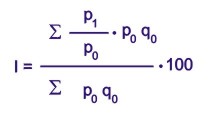
- p1- price of goods (service) in current period
- p0 - price of goods (service) in base period
- q0 - sold (realised) quantity of goods (service) in base period

The calculation of a chain index
Assume that a series of fixed-weight indices have been calculated with period 0 as the price reference period and that in a subsequent period k, a new set of weights has to be introduced in the index. The new set of weights may, or may not, have been price- updated from the new weight reference period-to-period k. A chain index is then calculated as:

- o - index reference period
- k - overlaping (link) period
- t - current period
Structure and base period of indices
Indices are published by 13 divisions, 48 groups and 118 classes of COICOP classification, within the framework of which individual divisions contain:
- 01 Food an non-alcoholic beverages - includes all types of food products and non-alcoholic beverages
- 02 Alcoholic beverages and tobacco - includes alcoholic beverages and tobacco products
- 03 Clothing and footwear - includes all types of men's, women's and children's textiles, clothing, footwear, including repairs, custom manufacturing and cleaning of these clothing items
- 04 Housing, water, electricity, gas and other fuels - includes rent, goods and services for regular maintenance and repairs of dwellings, water and sewage charges, all types of energy (electricity, gas, heat, solid fuels)
- 05 Furnishings, household equipment and routine household maintenance - includes furniture and furnishings, carpets and other floor coverings, household textiles, household appliances, tableware, glassware, household tools, repairs of household appliances, and goods and services for routine household maintenance
- 06 Health - includes medical and pharmaceutical products, therapeutic appliances and equipment, medical services, dentistry, hospital services, and other health services other than hospital services
- 07 Transport - includes personal transport equipment, including repairs and spare parts, fuel, lubricants, and public transport (rail, road, air), postal and courier services
- 08 Information and communication - includes information and communication equipment, including equipment for receiving, recording and reproducing sound and images, software, and information and communication services
- 09 Recreation, sports, and culture - includes a wide range of goods and services for recreation, sports, and culture (photographic and cinematographic equipment, toys, gardening supplies, recreational and cultural services, package holidays, books, textbooks, newspapers and periodicals, office and drawing supplies). From January 2026, the division was expanded to include gambling
- 10 Educational services - includes educational services, including fees for art schools, language schools, and courses
- 11 Restaurant and accommodation services - includes food and beverages in restaurants, catering services in workplace, school, and preschool catering, accommodation services in hotels, guesthouses, and hostels
- 12 Insurance and financial services - includes insurance and various financial services
- 13 Personal care, social protection, and various products and services - includes products, devices, and services for personal care, personal items, jewelry, clocks, watches, social care, and other services not classified elsewhere (fees for legal services, funeral services, advertisements, and others)
Base period of indices is average of year 2025 = 100.
For the needs of users, the indexes in the database are published to the basics:
- average of year 2025 = 100
- previous period = 100
- the same period of previous year = 100
Methodical Notes - Core and Net Inflation
Core and Net Inflation
Core inflation quantifies growth rate of price level on incomplete consumer basket. From the consumer basket there are excluded those items with regulated prices and items with prices influenced by other administrative measurements. The items which will be changed due to tax amendments (e.g. change of VAT, precise taxes, subsidies) stay a part of consumer basket, but influence of tax amendments is eliminated. Core inflation is quantified in two ways:
- as contribution of amended basket (in percentual points) to total inflation rate, amended changes of tax burdening of individual items of consumer basket.
- as growth of amended consumer basket prices (in percentage), amended changes of tax burdening of individual items of consumer basket.
Though, total inflation is divided into core inflation (influence of items with market prices), influence of items with regulated prices and influence of indirect taxes (elimination of tax amendments).
Contribution of core inflation represents the information by how much percentage should the price level be changed, if there is no price change due to administrative interference. It means that if there are no changes of administrative prices, contribution of core inflation is equal with total inflation.
Contribution of core inflation (in percentual points) to total inflation is further divided into contribution of net inflation and contribution of foodstuff prices. Reason for putting aside share of foodstuffs from net inflation was the fact that foodstuff prices in the past were determined by considerable seasonality as well as non-market measurements (e.g. changes of guaranteed prices for the first producers, subsidies, import taxes, quotas).
List of items with which there is adjusted consumer basket for calculation of core and net inflation
A. Items excluded from calculation of core and net inflation
1. Items with maximal prices
-
- approved by Transport Authority of the SR
- passenger railway transport
- approved by Regulatory Office for network industries of the SR
- water and waste water treatment
- electricity
- natural gas for households
- heat energy for households
- approved by Regulatory Authority for Electronic Communications and Postal Services
- post office services
- telephone and telegraph services
- approved by regional self-government and municipal self-government
- passenger bus transport
- city mass transport
- services connected with housing (cleaning and controlling chimney, sanitary services, etc.)
- social care services
- approved by Ministry of Construction and Regional Development of the SR
- net rent in rented dwellings
- approved by Ministry of Health of the SR
- selected items of medicines and services in health care
- approved by Ministry of Education of the SR
- school and kindergarten boarding
- approved by Transport Authority of the SR
2. Fees
- fees for kindergarten and school education
- fees for verification of signature in certificates, passport issuing, extracts from criminal record
- and other fees for legal acts
- fee for dog
B. Items in which there are eliminated price impacts resulting from tax amendments, but which are not excluded from consumer basket
- VAT
- excise taxes
Principles of calculation of core and net inflation
- From the consumer basket there are excluded those items with regulated prices stated under the point A. List of these items will be up- dated annually, always in January of given year according to the Price Bulletins of the Regulatory Offices SR and declarations in Digest of Laws. The list of excluded items will be valid throughout the whole year regardless possible price liberalisation, which might happen during the year.
- The items which price will be changed due to tax amendments, these are the items stated under the point B, remain a part of consumer basket, but influence of tax amendments is eliminated. Elimination of price changes will take place in that time period, when tax amendments will become valid. The list of items, whose price change will be eliminated, will be updated continuously according to Laws of the NR SR declaration in Digest of Laws.
- The items which stay in the consumer basket for calculation of core and net inflation are assigned the same weights as in total consumer basket.
Formula for calculation of core inflation
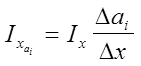
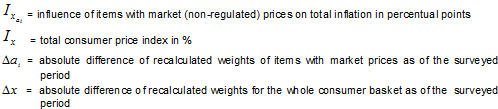
Methodology on calculation of indices of dwellings´ realization prices
For the calculations of Real Estate Price Indices for Housing, the Statistical Office of the Slovak Republic has been using a new source of data since the second quarter of 2021 - the database of the Office of Geodesy, Cartography and Cadastre of the Slovak Republic (UGKK SR) or the so-called Land Register.
The database contains real estate prices from all transactions entered in the UGKK SR database in the given quarter. Realization price indices of residential real estate are calculated on a quarterly basis, broken down into new and existing real estate. The calculation is performed according to the Laspeyres-type formula based on the base of the 4th quarter of the previous year = 100, while the calculated indices are then converted to the base of the average of 2010 = 100 using the index of the 4th quarter of the previous year. The basic unit of measurement is the price per m2, which we obtain as a share of the price paid for the property and the area of the property.
The weighting scheme for the calculation of price indices is based on the expenses associated with the purchase of real estate in the previous year. The weighting scheme is updated annually, while the basis for updating the weighting scheme is expenditures for the period t –-1. Scales are not price updated.
Until the end of the first quarter of 2021, the indices were calculated from prices obtained from the Price Map filled in from the database of the National Association of Real Estate Agents of Slovakia (NARKS). The database contained, among other things, data on realization prices of real estate, which were obtained from actually executed transactions carried out through real estate agencies associated in NARKS. Average realization prices by districts were obtained from the database in terms of m2, broken down according to the specified characteristics of the property (family house, flat, age of the property, number of rooms).
Methodical Notes – Producer Prices
Price of producer is the negotiable price that is agreed between producers and customers inland without VAT (without costs on transport to customers and costs connected with transport) that is invoiced for more significant commercial cases conducted in the middle of relevant month.
Price indexes are created as selective indexes of constant composition (a change effect of structure on price index level is excluded). Total indexes are calculated by aggregation of individual simple price indexes of representatives through suitable systems of basic year weights. Index figures (systems of weights, representatives, and respondents) are re-evaluated and accommodated to relevant structures in regular five-year intervals.
Index of agricultural products prices contains information on prices development for 117 main vegetal and animal agricultural products. The prices are surveyed directly at selected agricultural producers, without VAT. Producers during sale set these prices, including interventionist purchases.
The system of constant weights, which is derived from the average structure of agricultural production purchase from the year 2019 to 2021, is used at aggregate calculation. The prices of constituent months in the year 2020 are the basis for the calculation of the price index.
Prices index figure of construction works contains about 9 000 representatives (selected items of construction works). Weights were derived from the structure of construction production in the year 2021. The price basis there is the average of 2021.
The construction materials and components price indices (producer prices) includes 95 different branches of material and components used in the construction industry. The weights for the calculations of indices are derived from the relative ratio of a representative value in the entire construction industry in 2021. The base of the indices is the average of 2021.
Methodical Notes - Industrial producer price indices
A comprehensive revision of Industrial Producers Price Indices (IPPI) was undertaken in 2022, in the framework of which the weighting system, sampling of price representatives and domestic reporting units (respondents) were revised. Weights applied to individual models were chosen, based on turnovers in domestic industrial production, or turnovers in industrial products for export in 2021. At the same time, the reference period was moved to December 2021 (before it was December 2015).
Based on the published time series of industrial producers price indices, both domestic and export-oriented, the weighting scheme has been constructed to calculate the composite industrial producers price indices.
Within the harmonized system EU, IPPI has been published as the main indicator, according to the NACE Rev. 2 classification since 2009.
Structural and organizational changes in the economy, technological and technical progress has resulted in the emergence of new economic activities, which come to replace the current activities and products. Such changes often call for a modification of applied classifications of economic activities. European and international classification systems underwent a major change in the period 2000 - 2007. This revision applied to all international classifications of economic activities (NACE, CPA, PRODCOM). On 29 October 2014, the European Parliament and the European Council issued a new Regulation No. 1209/2014, which introduces a new statistical classification of products according to activities (CPA 2015). The Decree of the Statistical Office of the Slovak Republic (published on June 18, 2007) introduced the NACE Rev. 2 (OKEČ), which is also applied to IPPI from January 1, 2009 onwards.
The respective weights for IPPI were established, based on structure of turnovers in industry of the SR in 2021, and "One-off survey aimed at sampling the representatives of the price level for industrial producers" (applied to products, classified according to the NACE Rev. 2, and broken down to divisions 05 up to 39).
IPPI does not include extraction and processing of uranium and thorium ores, publishing, production of nuclear fuels, production of weapons and munitions, production of aircrafts and spaceships, industrial services.
IPPI is constructed based on simple price indices for individual representatives, weighted against a relative share of a relevant representative in the total turnovers in industry in 2021 (unchanged structure), following Laspeyres formula.
- where:
- p1 - price in a current period
- p0 - price in a base period
- q0 - production (sale, output) in a base period
The present publication contains price indices for groups, which are aggregated into divisions, subsections, sections and industry total according to the NACE Rev. 2 Industry total refers to the aggregation of sections B, C, D and E. IPPI of the year 2011 is adjusted by coefficients to revised scheme conditions.
IPPI time series of basical indices (December 2021 = 100, or average 2021 = 100) will be recalculated from year 2008 till year 2023 by new classification NACE Rev.2. Recalculated time series (domestic, non- domestic and total) will be published at Statistical office SR´s website.
There are not published in the tables all surveyed divisions of NACE Rev.2
Legend:
- Full stop (.) instead of a number, means that the data is not available
- Upper-case (D) data cannot be realeased for individual protection reasons
Methodical Notes - Price indices of construction works, materials and components used in construction industry
In 2022 was prepared a new statistical model for the calculation of price indices of construction work, materials and products used in construction. The revised index scheme includes about 9 000 representatives - selected types of construction work. Collected prices of the selected representatives include all materials, complete costs of building of the structure (object) and profit. For the purpose of the collection of prices of the representatives in enterprises with construction as prevailing activity were prepared questionnaire (Prices Constr 10-04). This questionnaire is completed quarterly by 200 responders in Slovakia. The reporting network covers the subjects selected by kind and value of construction output and by territorial aspect regardless of their legal form. Reporting on prices follows the methodology explained in the notes in questionnaire.
A new weighting system was calculated on the basis of the structure of construction output in SR and a detailed special statistical survey on construction output in 2021. The weighting schema allows to aggregate price indices into types, divisions, groups and categories according to Classification of types of Construction (CC). Price base is the average of 2021.
European and international classification systems underwent a major change in the period 2000 – 2007. This revision applied to all international classifications of economic activities (NACE, CPA, ...). On April 23, 2008, the European Pairlament and the European Council issued a new Regulation No. 451/2008, which introduces a new statistical classification of products according to activities (CPA 2008). The Decree of the Statistical Office of the Slovak Republic (published on June 18, 2007) introduced the SK NACE Rev. 2, which is also applied to publications from January 1, 2009 onwards.
The values of the published indices also include the prices of assembling work. Separately are given the indices for repairs and maintenance of the construction nature. Other indices are calculated as aggregates for the new construction, modernisation and reconstruction.
Indices are calculated from the average price indices of individual representatives which are weighted by a relative ratio of the value of a representative to the total output value total 2021 construction output (constant structure) by the Laspeyres formula.
- p1 - price of the representative in the current period
- p0 - price of the representative in the base period (Average of Year 2021)
- p0q0 - the value volume of the construction works in the base period
The construction materials and components price indices (producer prices) includes 95 different branches of material and components used in the construction industry. The weights for calculations indices are derived from the relative ratio of representative values in the total construction industry in 2021. The base of the indices is the average of 2021.
Besides the construction materials and components price indices calculated from the producer prices are price indices from the purchase prices (the prices which enterprises pay for construction material) are also calculated. The statistical model contains 97 groups of materials and components by the classification of products by activity (CPA). The principle of the calculation is similar to the calculation price indices from producer prices. The base of these indices is the average of 2021.
Methodical Notes - Producer price indices of agricultural products
In 2023, based on the respective decision of EUROSTAT, the Statistical Office of the Slovak Republic undertook a revision of the price indices of agricultural products, which consisted of: - moving the reference period (to the year of 2020, from 2024 onwards, before prices were compared with the year 2015),- changing the weighting system (before it was based on monthly averaging of turnovers for 2014-2016, now the period 2019-2021 is applied), reducing the number of price representatives (in sample) from 85 to 117, by excluding those of little relevance to the Slovak situation, updating, and extending the number of respondents to about 550.
Prices of agricultural products are surveyed on a monthly basis by using the official statistical form “Ceny Poľ NC 1-12” for selected agricultural products, for all types of business ownership (i.e. co-operatives, state-funded organizations, as well as private sole-proprietors). Only the main agricultural products in specified quality categories were selected. for price survey. Crop products including fruit and vegetables and animal products including fishes are included in the questionnaire.The prices are surveyed as a non-weighted arithmetic average of prices of all major business cases of a given organization, which were registered were registerid in the calendar mouth. The price presented does not include VAT. Besides this, the respective official survey collects information on sales, in terms of quantity and value of selected price representatives for all quality categories (excluding inferior goods and emergency slaughtering), as an aggregate for the whole previous month. These data are then imputed into the calculation of average values. Average prices of the monitored agricultural products are calculated as an arithmetic average of prices offered by individual producers, for the country as a whole, or at the level of regions. Price indices are calculated based on prices reported for 117 selected products price representatives (samplers).
Simple indices are then aggregated into groups and totals, through the constant monthly weighting system, following Laspeyres formula:
- p1 - price in the monitored period,
- p0 - price in the reference period (i.e. prices for individual months as reported in 2020),
- p0q0 - the respective weight, derived from the value of sales registered in the reference period (average of the 2019-2021 period), in relative terms
Methodical Notes - Prices of deliveries of goods and services into agriculture sector
Prices of deliveries of goods and services into the agriculture sector are being surveyed quarterly through the means of state statistical questionnaire "Ceny Pol D 1 - 04" on a sample of agricultural producers regardless of their ownership form (organizations of co-operative type, state owned, or private persons).
Prices are obtained as simple arithmetic mean of important, in regards to volume, purchases of selected goods and services in the surveyed quarter. In the last month of each quarter (i. e. in March, June, September and December) the prices of important, in regards to volume, purchases conducted by the 27th calendar day of last month of the surveyed quarter are put in the average. The prices do not include VAT.
Average prices of surveyed representative products are being calculated as the arithmetic mean of individual prices reported by individual respondents.
The index scheme of prices of goods and services supply into agriculture was submitted to complex revision. In the framework of this revision which was carried out in 2023 the sample of respondents and representative products (representatives) had gone through. At the same time a shift in basic period to average of 2020 came into force and the index calculation was changed according to a new weighting system derived from expenditure structure of purchase of goods and services being consumed for agricultural achievement in 2020.
The calculation of a quarterly price index of inputs into agriculture is based on following components:
- Price indices obtained by means of direct survey: from processing of return forms "Ceny Pol D 1 - 04". The prices of about 100 representatives of 26 product sub-groups according to Classifciation of Production (KP), which are considered important from the point of view of agricultural production (prices of seed delivery, fodder, agrichemicals, fertilizers es of selected services in agriculture: agri-chemical, veterinary and breeding), are being surveyed through said forms;
- Price indices related to selected groups or classes in KP-classification, as taken over from industrial producer price index, water and sewage rate index, building and construction and telecommunication performance price indices.
For calculation of quarterly input into the agriculture price index, the Laspeyres formula is used:
- p1 - price in current - surveyed period
- p0 - price in base period (average of 2020)
- p0q0 - constant weight: value of cost for purchase of goods and services consumed in agriculture sector (in 2020)
 Help
Help